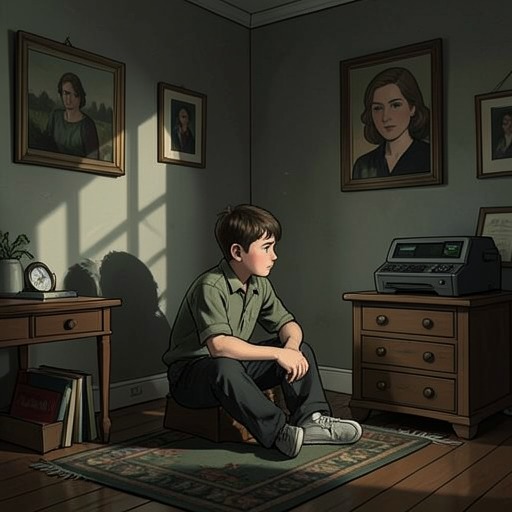
Kinsenin Hospital
Call Me YoursThe psychiatric hospital is both a place of confinement and the principal setting of the novel’s psychological revelation. Kayla arrives believing that she has been abducted and wrongfully imprisoned, but the hospital gradually exposes the hidden structure of Jamie Cooper’s identity, the traumatic origins of his dissociation, and the possibility of recovery through sustained therapy and family support.
Definition and First Arrival
Kayla is brought to the psychiatric hospital after Dr. Reid Francois explains that Don has attempted to harm her. Her first encounter with the institution is marked by force rather than consent: she wakes in the doctor’s office, discovers that her hands and legs have been strapped to a hospital bed, and learns that Adi is being kept away from her for safety. Although Dr. Francois loosens the restraints, Kayla remains unable to accept the hospital as a place of care. When she demands to go home and call her chauffeur, Jessica tells her that she must stay there, turning the hospital into a direct conflict between clinical authority and Kayla’s sense of personal autonomy.
The setting reinforces her terror. Male nurses lead her through a hallway with white walls, double glass doors, and security guards. The smell of disinfectant seems to mask the odor of decomposition, while a patient in a wheelchair stares blankly into space. Through an open doorway, Kayla sees other patients strapped to beds and imagines that she will become one of them. She finally stops resisting and follows the nurses because she believes that continued struggle may destroy her life. The hospital’s architecture therefore functions as a social and psychological force: locked doors, restraints, uniforms, and surveillance make treatment indistinguishable from captivity from Kayla’s initial perspective.
The Identity Revelation
The hospital is where Jessica finally tells Kayla that she is not an independent woman with a separate biography, but one of Jamie Cooper’s alters. Jessica identifies Jamie as having dissociative identity disorder and names Davis, whom Kayla recognizes as Chris Davis. This disclosure transforms the meaning of the earlier story. Kayla’s relationship with Chris Davis, her correspondence with him, and her conviction that she possesses an identity separate from Jamie are reinterpreted within Jamie’s dissociative system.
The revelation is not delivered in a moment of calm recognition. Kayla is frightened, furious, and resistant, while Jessica struggles to continue speaking. Kayla’s placement in the hospital thus makes the institution a site of anagnorisis, but the knowledge arrives as a wound rather than a simple resolution. It removes the apparent certainty of Kayla’s selfhood without immediately giving her a stable alternative. Her question about whether Dr. Francois intends to eliminate her so that Jamie can reclaim his body shows how completely the hospital’s medical language has been absorbed into her fear of erasure.
The letters become a crucial object in this process. After the nurses lock Kayla in a small room, she discovers the correspondence she has been carrying and realizes that Jessica stole her letters. Later, after five days without a reply from Chris, Jessica compares Kayla’s letters with the one she received from him and hires a calligrapher, who confirms that the letters were written by the same person. The hospital therefore gathers together two forms of evidence that compete with Kayla’s interpretation: the letters authenticate the writing while the diagnosis destabilizes the identity of the writer and recipient. The setting turns private correspondence into material for psychiatric and familial investigation.
Clinical Practice and the Meaning of Illness
Dr. Francois’s office offers a striking contrast to the locked ward. Kayla becomes accustomed to visiting it because the office does not smell like a chemical plant and its sofa is more comfortable for her back than the plastic-covered bed in her room. Yet even this comparatively gentle space remains implicated in institutional control. Dr. Francois asks Kayla to relax, helps place her on the examination table, and instructs Jessica to assist him. His treatment depends on access to Kayla’s body and mind, while her participation is shaped by confinement and by the threat of being returned to the ward.
The later consultation with Jamie’s family gives the hospital a more systematic medical role. In front of Jamie’s file, Dr. Francois explains that Jamie has dissociative identity disorder and, in his case, four separate personalities, while acknowledging that further alters could appear. He describes an alter as controlling the host until another alter takes over and presents dissociation as a coping mechanism for situations a person cannot otherwise face. He also states that there is no immediate cure or medication for the disorder, although medication may reduce symptoms such as depression and anxiety; psychotherapy is the principal means of helping Jamie manage his condition.
Dr. Francois connects Jamie’s dissociative amnesia fugue to his failure to remember Adi. Jamie had struggled to accept that he was not a girl and had consequently believed that he was unloved. According to the doctor’s explanation, Kayla emerged from this conflict, while the existence of a daughter could have threatened to revive memories of childhood trauma, leading Jamie to block Adi from awareness. The hospital’s diagnosis therefore does more than label Jamie: it supplies a causal account linking gendered shame, traumatic memory, dissociation, and family estrangement. At the same time, the explanation risks reducing the complexity of the alters to a clinical mechanism, making the hospital a place where subjective lives are both interpreted and categorized by professional authority.
Family, Governance, and Recovery
The hospital’s care is inseparable from decisions made by others on Jamie’s behalf. Jessica visits Kayla every day and remains the only familiar face in the facility, even though Kayla knows that Jessica stole her letters and helped place her there. This creates an unstable mixture of suspicion and dependence. Kayla gradually comes to like having Jessica around, but trust remains difficult because the same person who offers comfort has participated in the confinement that Kayla experiences as betrayal.
The institution also reorganizes the family’s future. Jessica tells Adi that Jamie will remain in the hospital for some time and that they plan to sell the houses and mansion, buy a smaller home, and start over after his discharge. She also says that Blake will manage the hotel, that a publicist will address questions about Kayla, and that Kayla’s attorneys know the situation. The hospital thus becomes the center from which property, employment, publicity, guardianship, and family contact are redirected. Treatment is not isolated from social governance; it determines where the family will live, who will control the hotel, and how Kayla’s public disappearance will be explained.
Dr. Francois emphasizes that Jamie needs a strong support system and that recovery may take years. The family’s behavior eventually supplies that support: Jessica and Adi visit every day, bring board games, and keep Jamie company, while Richard Cooper and Kimberly Cooper come every weekend. Their repeated presence is presented as a condition of discharge rather than a sentimental addition to treatment. After Jamie has spent a year in the hospital facility, therapy and family support have reduced his symptoms enough for him to return home. He no longer suffers from migraines or difficulty sleeping, and he and Little Jay have begun to pick up the pieces of his life. Little Jay, once afraid and ashamed, has learned that he is safe.
Narrative Significance and Ending
The psychiatric hospital changes meaning across the plot. For Kayla, it begins as a hellhole filled with restraint, locked doors, chemical smells, and patients who seem to have lost their souls. For the family, it becomes a controlled environment in which Dr. Francois can explain Jamie’s condition, coordinate long-term therapy, and monitor his gradual return to stability. For the narrative, it is the threshold between a false but emotionally convincing social world and the buried history that produced it.
The hospital’s final significance lies in its refusal to make recovery instantaneous. Dr. Francois says that memory may return on its own or through triggers and therapy, and that the separate parts of Jamie’s identity may eventually become one. The ending confirms progress without pretending that the damage was superficial. Jamie is able to leave only after a year of treatment and sustained family care. When Adi runs into his arms at home, the embrace completes the hospital’s movement from enforced separation to restored relationship: the daughter whom Jamie had been unable to remember becomes the person whose welcome confirms that he has begun to return to his life.